
Look around a room of 40-year-olds and you will notice stark differences. Some possess the energetic capacity, joint resilience, and skin elasticity of a 28-year-old, while others exhibit the metabolic slowing and chronic fatigue associated with late middle age.
This variance exists because chronological age-the number of times the Earth has orbited the Sun since your birth-is a remarkably poor proxy for human biological function. Instead, cellular state is dictated by your epigenetic biological age.
1. Chronological vs. Biological Age
Chronological age is static and irreversible. Biological age, by contrast, evaluates structural cellular integrity, DNA mutation repair capability, mitochondrial capacity, and systemic inflammation.
While your foundational genomic DNA code remains stable throughout life, your epigenome dynamically determines which genes are actively read and expressed. Environmental factors, lifestyle protocols, cellular stress, and nutrient availability dictate these regulatory switches.
Key Distinction
Chronological age tracks time passed. Epigenetic biological age tracks structural cellular decay and operational capability.
2. What is DNA Methylation?
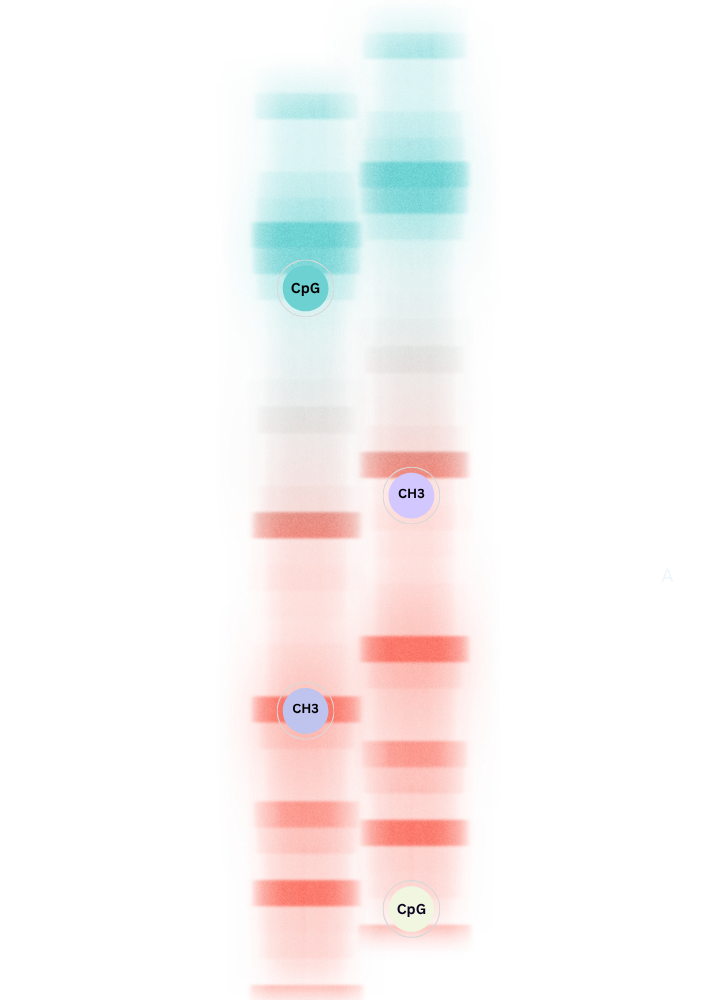
At the biochemical level, DNA methylation is the primary mechanism through which the epigenome controls genetic expression. It involves the attachment of a tiny chemical tag-a methyl group ($CH_3$)-to specific nucleotides within the DNA strand.
When methyl groups bind to regulatory regions of a gene, they typically silence or down-regulate its transcription. Conversely, the removal of methyl groups (demethylation) allows cellular machinery to access and transcribe that gene.
3. CpG Islands & Epigenetic Clocks
DNA methylation occurs predominantly at locations where a cytosine nucleotide is immediately followed by a guanine nucleotide—a pair known as a CpG site. Genomic regions with dense clusters of these pairings are designated as CpG islands.
As human cells replicate over decades, CpG island methylation patterns alter in predictable trajectories. Algorithms known as epigenetic clocks cross-examine these specific methylation loci to calculate biological age with profound statistical precision.
4. Biological Age Velocity Analysis
Measuring biological age yields an actionable metric termed Aging Velocity (or Pace of Aging). An individual aging at a rate of $0.85$ biological years per chronological year is actively building functional biological reserve. Conversely, an individual with an aging velocity of $1.30$ accumulates cellular damage at an accelerated rate.
Advanced biological age models, such as Lami Health's LongevitYY protocol, extend beyond a single top-level age score by analyzing specific organ system metrics:
- Neural / Brain Age: Evaluating neuro-epigenetic markers and cognitive decline traits.
- Metabolic Age: Assessing cellular nutrient sensitivity, mitochondrial efficiency, and lipid clearance.
- Immune & Inflammatory Pacing: Quantifying systemic low-grade inflammation (inflammaging) and immune senescence.
5. Can Epigenetic Age Be Reversed?
Unlike your underlying genetic sequence, epigenetic marks are malleable and reversible. Landmark scientific trials have demonstrated that targeted biochemical, dietary, and lifestyle protocols can reset methylation tags on critical repair genes.
Reversing cellular decay requires a data-driven feedback loop:
- Establish Baseline: Conduct an at-home epigenetic saliva swab like LongevitYY to calculate your exact CpG methylation baseline.
- Implement Targeted Protocols: Apply precision nutrition formulations tailored to your LamiDNA genomic profile to supply key methyl-donors (such as methylated folate, B12, and polyphenols).
- Track Telemetry: Monitor real-time recovery metrics, HRV, and sleep efficiency via the LamiFit mobile app.
- Re-test & Optimize: Measure epigenetic drift changes every 6 to 12 months to confirm biological age deceleration.
Frequently Asked Questions
What is the difference between chronological age and biological age?
Chronological age counts the calendar years lived. Biological age measures true structural health and functional capacity of cells based on DNA methylation accumulation.
How does DNA methylation act as an aging clock?
DNA methylation attaches chemical methyl groups to CpG islands on DNA strands. As cells age, these tags shift predictably, allowing epigenetic algorithms to calculate cellular age.
Can epigenetic biological age be reversed?
Yes. Because epigenetic marks are dynamic, targeted precision nutrition, lifestyle optimization, and cellular interventions can restore optimal gene expression and reduce biological age.